Blog
How AI and Video Analytics Are Transforming Operating Room Outcomes
Learn More

Caresyntax Blog
January 22, 2026
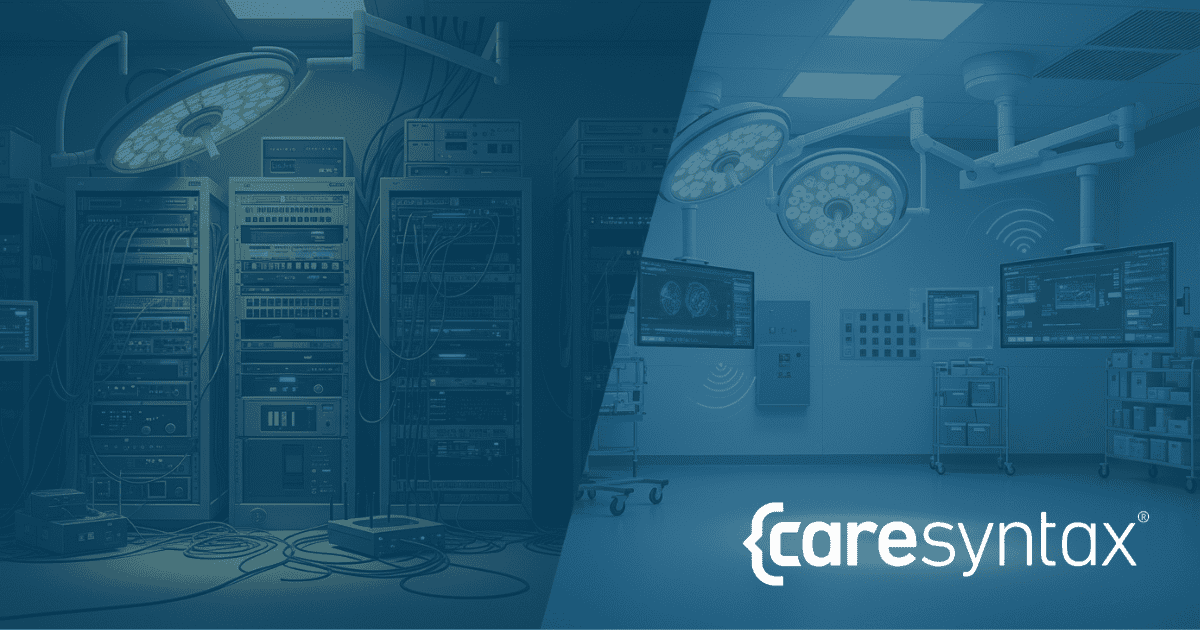
Walk into most operating rooms today and you’ll find a peculiar contradiction. The surgical team is performing procedures that would have seemed like science fiction twenty years ago. Meanwhile, the technology connecting their equipment runs on a philosophy that predates the smartphone.
Those proprietary boxes bolted to the wall? The custom video routers humming in the equipment closet? They were state-of-the-art once. Now they’re anchors.
Traditional OR integration systems work exactly as designed. That’s the problem.
A hardware-based integration platform does one thing well - it routes video from Point A to Point B and records what happens along the way. It was built for a world where laparoscopic cameras and overhead lights were the extent of “connected” surgery.
And here’s the part that makes CFOs wince: adding one new capability often means replacing everything. Hardware generations don’t mix well.
The phrase “vendor lock-in” gets tossed around boardrooms like it’s a minor inconvenience. It’s not.
When your OR integration depends on proprietary hardware, you’ve handed the keys to your surgical infrastructure to a single company. They set the upgrade timeline. They determine which new devices get supported. They decide what “maintenance” costs.
A health system we work with described their previous situation bluntly: “Every time we wanted to add something new, we had to go back to the same vendor, hat in hand, and accept whatever they quoted. We weren’t customers anymore. We were captives.”
Multiply this across a dozen ORs. Across multiple facilities. Over a decade of technological change. The numbers get uncomfortable fast.
The shift happening now mirrors what’s already transformed every other technology-dependent industry. The intelligence moves from hardware to software. The physical infrastructure becomes a commodity. The value lives in code that can be updated, extended, and improved without sending someone to unscrew a panel.
In a software-defined OR, lightweight edge devices handle the physical connections - capturing video, interfacing with devices, ensuring low-latency performance where it matters. But the integration logic, the analytics, the workflow intelligence? That lives in software layers that can evolve independently of the hardware underneath.
It’s the difference between a flip phone and a smartphone. Same basic function. Entirely different potential.
Your timeline shrinks. New device in the OR? Update the software. New imaging modality? Update the software. Surgical team wants to trial a workflow change? They can test it next week, not next fiscal year.
Your data starts working. Hardware systems capture video and call it a day. Software platforms can actually understand what’s happening in that video – identifying surgical phases, tracking instrument usage, flagging events that matter for quality and safety. The same footage becomes raw material for continuous improvement rather than a liability sitting on a server.
Your ORs become consistent. Scaling a software platform means deploying the same capabilities everywhere simultaneously. A surgeon walking into any OR at any facility encounters the same interface, the same data, the same intelligent assistance. Hardware systems, by contrast, tend to fossilize at different evolutionary stages across a health system.
Your costs behave differently. The first OR costs the most. Each additional room costs less. New capabilities arrive through updates rather than capital projects. The CFO’s spreadsheet starts looking fundamentally different.
Numbers matter. So does this: what happens when the circulating nurse doesn’t have to troubleshoot a frozen video feed? When the surgeon can access relevant patient data without breaking scrub? When documentation happens automatically instead of requiring thirty minutes of keyboard time after the case?
The staff who work in software-defined ORs describe something that sounds almost anti-climactic: the technology just works. It stays out of the way. It handles the complexity so humans can focus on the patient.
That’s not a small thing. OR teams operate under constant pressure - time pressure, cognitive load, high stakes for every decision. Technology that reduces friction rather than adding it might be the most valuable feature of all.
Caresyntax started with a simple premise: the operating room deserves the same software-first approach that’s transformed everything from transportation to communication. We built a platform that treats hardware as interchangeable commodity and software as the source of value.
That means genuine device interoperability - not just the devices one vendor happens to manufacture, but the devices a surgical team actually wants to use. It means integration with EMRs, PACS, scheduling systems, and whatever else a health system runs. It means analytics and AI capabilities that improve continuously, deployed to every OR simultaneously.
The goal isn’t impressive technology for its own sake. It’s ORs that adapt to their users instead of demanding adaptation from them.
Early adopters of software-defined OR infrastructure have been running this way for years now. They’ve collected the efficiency gains, the data insights, the operational flexibility. More importantly, they’ve established a foundation that can absorb whatever surgical innovation comes next.
Health systems still running hardware-centric integration face a different trajectory. Each year, the legacy systems fall further behind. Each upgrade cycle requires more compromise. Each new technology requires more creative workaround.
Health systems still running hardware-centric integration face a different trajectory. Each year, the legacy systems fall further behind. Each upgrade cycle requires more compromise. Each new technology requires more creative workaround.
The transition isn’t a question of if. The question is how much ground you’re willing to give up while you wait.


Caresyntax is the only vendor-neutral, enterprise-scale surgical technology data platform you need to make surgery smarter, safer, and more profitable. We offer software, data, and professional services solutions across the entire surgical continuum.